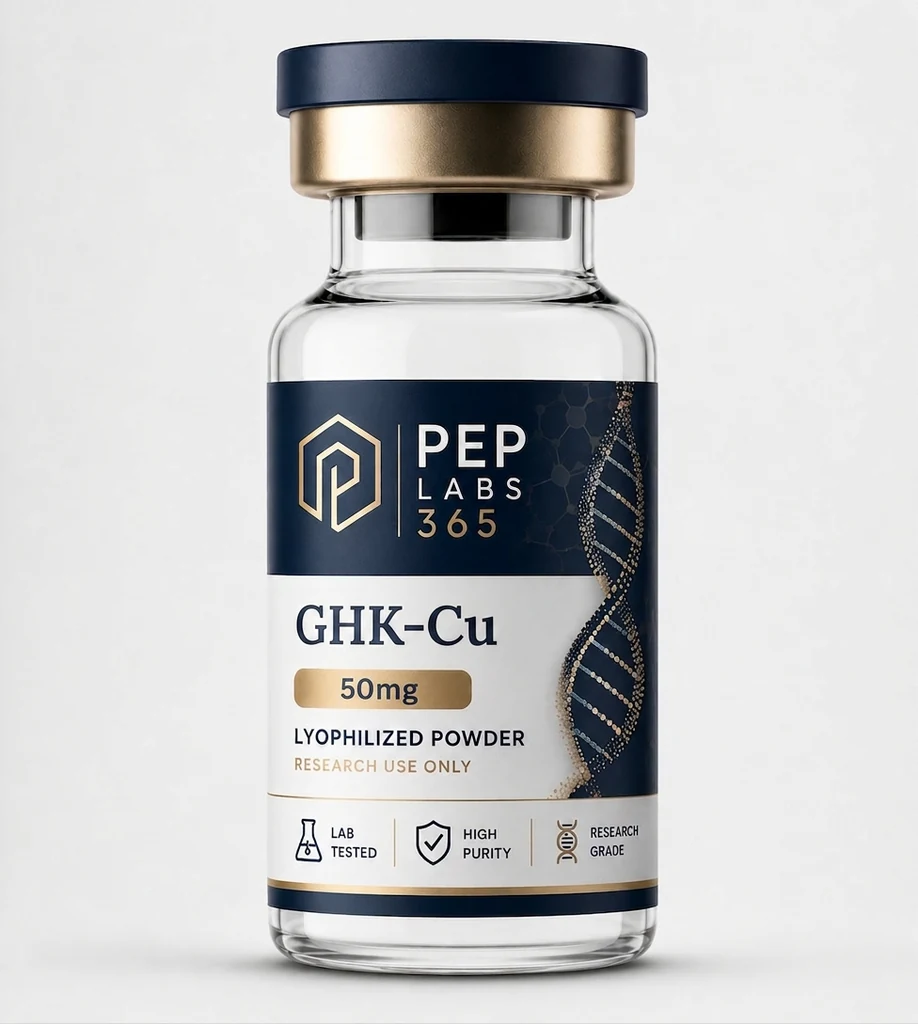
GHK-Cu — the copper peptide — research profile covering complex chemistry, signaling, and laboratory verification, written for Texas research labs.
Written for the Texas research community, this reference brings together the documentation Texas dermatology and cosmetic research groups reference on GHK-Cu that labs from Austin to Houston, Dallas to San Antonio typically request when qualifying a new lot. Every batch we dispatch from our Texas warehouse ships with the analytical documentation described below.
GHK-Cu is the copper-bound complex of the tripeptide glycyl-l-histidyl-l-lysine (GHK). First isolated from human plasma, the complex is one of the most extensively documented bioactive peptides in dermatological and tissue-research literature — and a common staple of Texas cosmetic-science bench work.
Complex chemistry
The GHK sequence coordinates a divalent copper ion (Cu²⁺) through the imidazole nitrogen of histidine, the α-amino group of glycine, and the deprotonated peptide nitrogen. The resulting square-planar complex is the signaling-active species and produces the characteristic deep-blue color used during qualitative batch verification.
Documented research signaling
- Modulates expression of genes related to extracellular matrix turnover in cultured fibroblasts.
- Influences SOD and antioxidant enzyme expression in published in-vitro models.
- Demonstrates affinity for collagen and decorin binding sites in laboratory studies.
- Reported to support angiogenic markers in cell-culture wound-model literature.
What a verified GHK-Cu COA includes
- ≥98% HPLC purity of the GHK peptide
- Quantified copper content (~17–20% by mass for the 1:1 complex)
- LC-MS confirmation of GHK mass (340.4 Da)
- UV-Vis absorbance at ~620 nm consistent with the Cu²⁺ complex
Is GHK-Cu the same as the copper peptide?
Yes. "Copper peptide" and "GHK copper peptide" both refer to the GHK-Cu complex.
What does the blue color mean?
The deep blue color is the absorbance signature of Cu²⁺ coordinated by GHK and is a qualitative indicator the complex has formed correctly.
Pep Labs 365 ships every research peptide from our Texas facility with a lot-matched Certificate of Analysis, third-party HPLC purity, and LC-MS identity confirmation.